
Rookery Isles
The Governance of the Rookery Isles
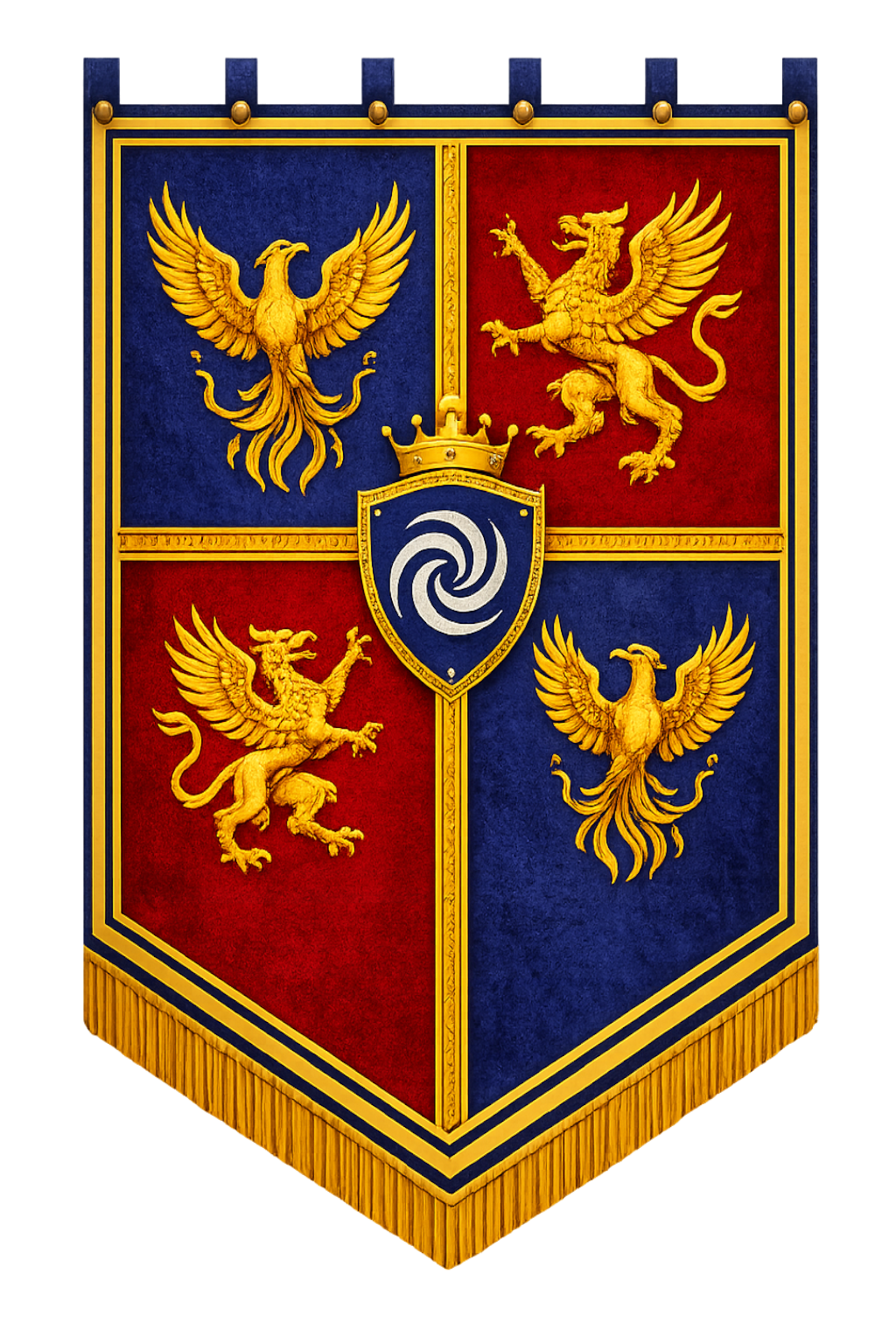
How the Rookery Isles Are Governed
For most of their history, the Rookery Isles had no central government. Each nation ruled itself. Dukes, Princes, Councils, and Chieftains governed their own lands, made their own laws, and settled their own disputes. Sometimes through diplomacy. More often through war.
When Ashley and Trystane descended as the Celestials and fulfilled the ancient prophecy, everything changed. Not overnight, and not without resistance, but the Isles were brought under a single authority for the first time in their existence. The prophecy had been known for generations. When two divine beings arrived with the power and the will to make it real, the nations of the Isles accepted what they had always known was coming.
But the Celestials did not come to rule every dispute, settle every grievance, or manage every harvest. They came to establish order and protect the Isles from the threats that mortal hands could not handle alone. The day to day business of governing a realm of competing nations, ambitious lords, and ancient grudges was left to mortals.
What the Celestials built was a system with two pillars of mortal power, balanced against each other, answerable to the Crown but independent of one another. Neither pillar can destroy the other. Neither can rule alone. And between them, the realm holds together.
The Celestial Court
Above all mortal authority sit Ashley and Trystane , the Celestials of the Rookery Isles. They rule from the Celestial Throne in Suncoast, and their word is final on any matter they choose to address.
In practice, they choose to address very little.
The Celestials possess the power to solve virtually any mortal problem. They choose not to. This is deliberate. Ashley and Trystane believe that mortals must be allowed to make their own choices, including their own mistakes. They intervene only when mortal decisions threaten the larger balance: existential threats, wars that would destroy everything, houses falling to ancient darkness, or violations of cosmic law.
Everything else is left to mortal hands. The politics, the trade disputes, the border arguments, the scheming and the backstabbing and the alliances forged over wine and broken before breakfast. That is the mortals' business, and the Celestials let them get on with it.
This is not indifference. It is trust. And it is a test that never ends.
The Regent
Current Regent: Beric Emberwave
Elected by the Small Council. Anointed by the Celestials. The voice and hand of mortal governance in the Rookery Isles.
The Regent is the most powerful mortal position in the Isles. Elected by the Small Council through vote and anointed by the Celestials, the Regent governs the realm. They set policy, mediate disputes between houses, command military campaigns, control trade agreements, and distribute the resources of the Crown. Once elected and anointed, even the Council members who voted against them must obey.
The Regent seat may be held by a single person or by a traditional pair, a Lord and Lady Regent ruling together.
This is where mortal politics truly lives. Every house in the Isles has an interest in who sits the Regent's seat. Every Council member who casts a vote is courted, bribed, threatened, or seduced by factions hoping to put their candidate in power. Elections are not gentle affairs. They are wars fought with words, favors, and leverage instead of swords, and the stakes are just as high.
The position is not hereditary. It is earned through votes and held through competence. Lose the Council's confidence, and a new vote can be called. The Regent rules at the pleasure of the Council and the blessing of the Celestials, and forgetting either of those facts has ended more than one political career.
The Regent cannot command the Hand of the Crown.
The Regent cannot direct House Sunflare.
The Regent governs the realm, but does not control its guardians.
The Hand of the Crown
Current Hand: Coffee Armwieller Allyrion
Appointed by the Celestials. Answerable only to Ashley and Trystane. The voice of divine authority in mortal affairs.
The Hand of the Crown is not elected. The Hand is appointed directly by the Celestials and answers only to Ashley and Trystane. Where the Regent represents the will of mortals, the Hand represents the will of the Crown.
The Hand runs court and council meetings. The Hand speaks with the voice of the Celestials on matters of celestial concern. And the Hand commands House Sunflare, the elite guardians and adventurers who serve as both the royal guard and the realm's first line of defense against extraordinary threats. No one else can command Sunflare. Not the Regent. Not the Council. Only the Hand.
The Hand does not rule the realm. That is the Regent's domain. The two exist in balance, equals with different authorities, neither able to overrule the other in their respective spheres. The Regent governs. The Hand guards. When the two agree, the realm moves as one. When they disagree, the politics get very interesting very quickly.
There is one critical difference between the two positions. The Regent is elected and can be removed by vote. The Hand serves at celestial pleasure. Lose their favor, and you lose everything, instantly, without appeal, and without recourse. The Celestials giveth, and the Celestials taketh away.
The Small Council
The Small Council holds the appointed positions that advise the Crown, govern vital aspects of the realm, and most critically, elect the Regent. Each Council member gets a vote. Each vote is worth a kingdom's worth of political currency. Houses will scheme for years to place a sympathetic figure on the Council, because controlling enough Council seats means controlling who sits the Regent's chair.
Council members serve at the pleasure of the Celestials. Lose their favor, lose your seat. But while you hold it, you are one of the most powerful people in the Isles, and everyone who wants something from the government knows it.
- Spymaster - Controls information, secrets, and the intelligence networks of the realm. Knows things that other people would prefer stayed unknown. The quietest seat on the Council and often the most dangerous.
- Seneschal - Manages the capital's infrastructure and daily operations. Keeps Suncoast running, the trade flowing, and the machinery of government turning. Less glamorous than the other seats. No less vital.
- Marshal - Commands the military forces and strategic defense of the Isles. When armies march, the Marshal decides where they go and what they do when they get there.
- Grand Seer - The mystical advisor. Interpreter of prophecy, reader of omens, and the one person at the table whose counsel comes from something other than politics. Whether that makes the Grand Seer more trustworthy or less depends on who you ask.
The Balance of Power
The genius of the system, if it can be called genius and not simply the Celestials knowing exactly what mortals are like, is the balance.
The Regent has the authority to govern but cannot command the military arm of the Crown. The Hand has the Celestials' ear but cannot set policy or control trade. The Council elects the Regent but serves at celestial pleasure. The Celestials have ultimate authority but choose not to use it except in extremity.
Every piece checks every other piece. No single person, no single house, and no single faction can accumulate enough power to become what Rhaenor became. That is the point. The Great War taught the Isles what happens when one ruler holds unchecked authority and a dragon's temper. The system that replaced it was built specifically to make sure that never happens again.
Does it work perfectly? No. It works like any system run by ambitious, proud, stubborn mortals with old grudges and long memories. It creaks. It strains. Factions push at every boundary. But the boundaries hold, because behind all the mortal politics, two Celestials are watching. And everyone knows it.
Why It Matters
Three years ago, the Rookery Isles were a collection of independent nations at war with each other and with a tyrant who burned anyone who refused to kneel. There was no council, no regent, no central authority of any kind. Just fire, and blood, and the strong taking from the weak.
The system that exists now is only three years old. It is young, untested in many ways, and built on a foundation of nations that spent centuries governing themselves and see no particular reason to stop. Every Duke, every Prince, every Lord who sits at the council table remembers what sovereignty felt like. Some of them miss it. Some of them are quietly waiting to see if this new order holds, or if it cracks.
The Regent's authority is real. The Hand's authority is real. The Council's power is real. But all of it rests on the understanding that the Celestials are watching, that the prophecy was true, and that the alternative is what came before.
For now, that is enough.
CURRENT OFFICEHOLDERS:
Regent: Beric Emberwave
Hand of the Crown: Coffee Armwieller Allyrion
KEY RULE: The Regent governs the realm. The Hand guards it. Neither can command the other. The Celestials intervene only in existential matters. Everything else is mortal politics, and mortal politics is where the best stories happen.
The entire system is only three years old. It is new, untested, and built on top of centuries of national sovereignty. Characters from any house can have strong opinions about whether this works, whether it should work, or whether it is simply the Celestials' polite way of ruling everything without admitting it.